Monday, March 26, 2012
Ben Franklin on Beer
Fun fact, by the way: it seems Franklin never said the famous phrase "Beer is proof that God loves us and wants us to be happy." but rather said "Behold the rain which descends from heaven upon our vineyards, there it enters the roots of the vines, to be changed into wine, a constant proof that God loves us, and loves to see us happy." (source)

Sunday, March 25, 2012
A Purrrfect Read

Even my own kitty approves this book
Title: The Well-Read Cat (Originally titled: Des chats passant parmi les livres)
Author: Michèle Sacquin (Translated by Isabel Ollivier)
Publisher: Bibliothèque
nationale de France and Officina Libraria
Published in: 2010, Paris
Pages: 207
As the corny yet inevitable title of this review states, I have just
polished off a wonderful little book on cats through history. To be more
precise, this book is a sampling of images of cats found in the collections of the
Bibliothèque nationale de France. Anyone
who has visited the famed library (or at least its massive website at gallica.bnf.fr) knows that many treasures are to be found there. It
was only a matter of time before a cat lover, incidentally the library’s
curator, decided to fish out its feline photographs and imagery. Alongside the
panoply of paper cats (as the book calls them), we have the pleasure of reading
various quotes on these whiskered critters by famous authors. The main text is a
brief exploration of the history of the perception of cats in folklore and
popular culture. Thanks to the extensive holdings at the BnF, the author is
able to present cats not only in a European context, but a Middle-Eastern and
Asian one as well. One page might contain the photograph of an Egyptian cat
carved in a regal pose, while another will illustrate a turn-of-the-century French milk ad. Speaking of which, it is good to be
reminded that the book was previously published in French before being
translated in English and Italian (Gatti
di Biblioteca). Rightly so: the allure of this four-legged house-pet
reaches beyond geography, as pictures of Japanese pussies will attest to. The
reader of this book will also appreciate this last cheeky allusion as the
author does not shy away from more explicit symbolism and representations of
cats. Indeed, she reminds us that for the longest time, cats were not only
linked to witchcraft (in fact, regardless of colour until a few centuries ago),
but were equally a symbol of female sexuality. Our only qualm with this book is
the numerous mentions of other artwork not reproduced within these
pages. Then again, we must remind ourselves that the objective of the book is
to highlight only pieces found at the BnF. All in all, even though this book is a
relatively short read (easily accomplished in less than an afternoon as I have
done, sitting next to the lion statues at the Art Institute of Chicago where I
picked up my copy), one can spend hours looking at these wonderful
representation of cats through the ages. Do not miss this one, especially if
you have a feline companion of your own!

A new meaning to Persian cat...

One seriously creepy medieval puss...

A fine feline if ever there was.
Saturday, March 24, 2012

Weirdness at the Art Institute of Chicago

Have I ever mentioned I love Van Gogh? *Nerdgasm!*
Whenever I have time to kill in Chicago while
waiting for the train, I always make it a point to visit at least one new landmark. This
time, a visit to the Art Institute of Chicago was in order. Standing at its
present location since 1893, the institute boasts some of the best art in the
world, spanning continents and centuries. Sure enough, I kept an eye out for
weirdness! Here are a few gems I found (and keep in mind, a full afternoon’s
visit wasn’t enough to see even half of their exhibits!)

Peruvian Stewie Griffin?
Description: Jar with Anthropomorphic Figure.
Paracas. Ocucaje area, Ica Valley, south coast, Peru. 650/150 B.C. Ceramic with
resinous postfire paint.

Lay off the Doritos, Chihuahua.
Description: Figure of a Dog. Colima. Colima,
Mexico. A.D. 1/200. Ceramic and Pigment.

Speaking of dogs... the 15th century contender for
the World’s Ugliest Dog contest...
Description: Netherlandish. Emperor Heraclius Denied Entry into Jerusalem, 1460/80. Oil on
Panel.


Monkey orchestra! Words fail to describe how
awesome this is... now, if you give enough instruments to enough simians, will
they play Beethoven?
Description: Monkey
Band, c. 1765. Germany, Meissen. Moderled after Johann Joachim Kändler
(German, 1706-1775) or Peter Reinicke (German, active mid-18th century). Made
by Meissen Porcelain Manufactory (founded 1710). Hard-Paste porcelain,
polychrome enamels, and gilding.


Our Lady of the Not Impressed....
Description: South German. Triptych of the Virgin and Child with Saints, 1505/15. Oil on
Panel.
I also have half a dozen other pictures I’ve
decided to submit to Ugly Rennaissance Babies instead. Hopefully we’ll see
them there soon!
Friday, March 9, 2012
Yar... Here Be Pillagers...
It might sound strange to take a moment to rant on a humour-oriented blog, but sometimes the motion is called for. Reality TV showed us before that it can be about more than duck-faced oompa loompas from New Jersey with the likes of this acclaimed French-Canadian series, Destination Nor'Ouest:
But then the very worst rears its ugly head with this moronic atrocity, American Digger:
Behold the stereotypical "Ugly American": a fat tub of lard giggling away with his shovel and fucking backhoe (my apologies to my American colleagues and friends. Or more like my sincerest sympathies). But enough ad hominim attacks, just read these few gems from this polished turd, "We live and breathe the history, we're not out to rape and pillage the ground" (with a wonderful shot of him flinging dirt left and right like a mad animal). "We're historians" to which he adds: "But instead of reading about history [i.e. getting an education] we want to touch [i.e. rape] it".
Spike TV's website describes the show thus:
Spike TV travels around the country uncovering hidden treasure found in the backyards of everyday Americans in “American Digger.” This new unscripted original series follows former professional wrestler turned modern day relic hunter Ric Savage, as he and his team from American Savage target areas such as battlefields and historic sites in the hopes of striking it rich and capitalizing on unearthing and selling bits of American history. The only thing standing in their way are the homeowners themselves, who Savage must convince to allow them to dig up their property using state-of-the-art metal detectors and heavy-duty excavation equipment. What artifacts they find, they sell for a substantial profit, but not before negotiating a deal to divide the revenue with the property owners. The team from American Savage is comprised of recovery expert Rue Shumate, battlefield historian Bob Buttafuso, Ric’s wife Rita who manages the business and their 25-year old son Giuseppe, who provides tech support and is the “muscle” of the operation. Series premieres, Wednesday, March 21 @ 10:00 PM, ET/PT
Folks, that is not how archaeology is practiced. This is how archaeology is done: http://youtu.be/RK4imdXWkMQ (my apologies for not embedding: seems there's a limit to the amount of clips shown per post). What is the problem you might ask? Real archaeologist will carefully sift through soil to find anything and everything they can. They don't stop at coins and bullets, they look for shards of glass, nails, lead seals, animal bones, hell- even microscopic particles like pollen and seeds. Assembled together with the proper collecting and cataloging methods, all of these finds have the potential to unlock a complex and fascinating history behind the area you are working on. For example, you can determine people's diets and if they lived through times of plenty or famine. Thanks to minuscule traces like beads or leftover fabric, you can establish trade routes and patterns. Etc. Etc. Etc. I could go on writing a book on how the real beauty of archaeology and history goes beyond finding coins and bullets, but plenty of people have done that already, both in print and on TV. If you're new to your interest of history and archaeology, there is plenty of fine introductory material out there.
And don't get me wrong: metal detecting enthusiasts can be important to archaeology. They happen to stumble across interesting finds all the time. After all, it was thanks to such a hobbyist that Fort Saint-Joseph in Michigan was found despite professional surveys in the area since the early 1900's. However, any such enthusiasts of metal detecting should be likewise as responsible and report any finds to their local historical society to prevent further degradation of the site of interest. There is a difference between such authentic passionate amateur historians, the pros they befriend and help out, and this...
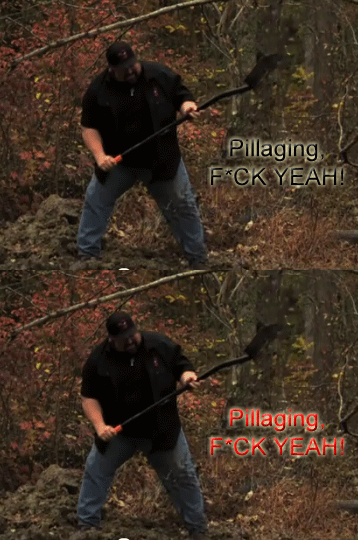
And don't get me wrong: metal detecting enthusiasts can be important to archaeology. They happen to stumble across interesting finds all the time. After all, it was thanks to such a hobbyist that Fort Saint-Joseph in Michigan was found despite professional surveys in the area since the early 1900's. However, any such enthusiasts of metal detecting should be likewise as responsible and report any finds to their local historical society to prevent further degradation of the site of interest. There is a difference between such authentic passionate amateur historians, the pros they befriend and help out, and this...
Oh, and did I forget to mention: a fucking backhoe???
What can you do to stop this show? Boycott it: don't watch it. Studios are very twitchy when it comes to ratings and will drop any new show like a rock if it doesn't show any promise of future audience augmentation. Also, you can write to Spike TV to express your disgust. Finally, spread the news: archaeology is cool! Grab a friend, spend a few hours in a museum, especially if he or she has never set foot in one. The more people are aware of the stakes involved in such nefarious activities, the more likely they are to boot such pirates off their property.
Further reading:
- Petition: Stop Spike TV from looting our collective past!
- American Digger: Show notes
- 'Diggers,' 'American Digger' TV Shows Said To Promote Looting Of Archaeological Sites
- Archaeologists Protest 'Glamorization' of Looting on TV
- Detroit preservationists oppose 'American Diggers' TV show
- Cable show host pleased with relics found in St. Augustine, scoffs at critics
- Facebook group: People against Spike TV's "American Digger"
Saturday, February 25, 2012
Weird Walt Disney
Stumbled on this gem for anyone fascinated by museums and archives:
Read up on the creepy Mickey Mouse gas mask here:
Tuesday, February 21, 2012
Cats + History = Purrrfect
Looking for your next feline fix and your next historical high? How about turning to this cute blog called Historical Cats @ http://historicalcats.tumblr.com/
 "Of all God's creatures there is only one that cannot be made the slave of the leash. That one is the cat. If man could be crossed with the cat it would improve man, but it would deteriorate the cat."
- Mark Twain Notebook, 1894
- Mark Twain Notebook, 1894
Subscribe to:
Posts (Atom)